
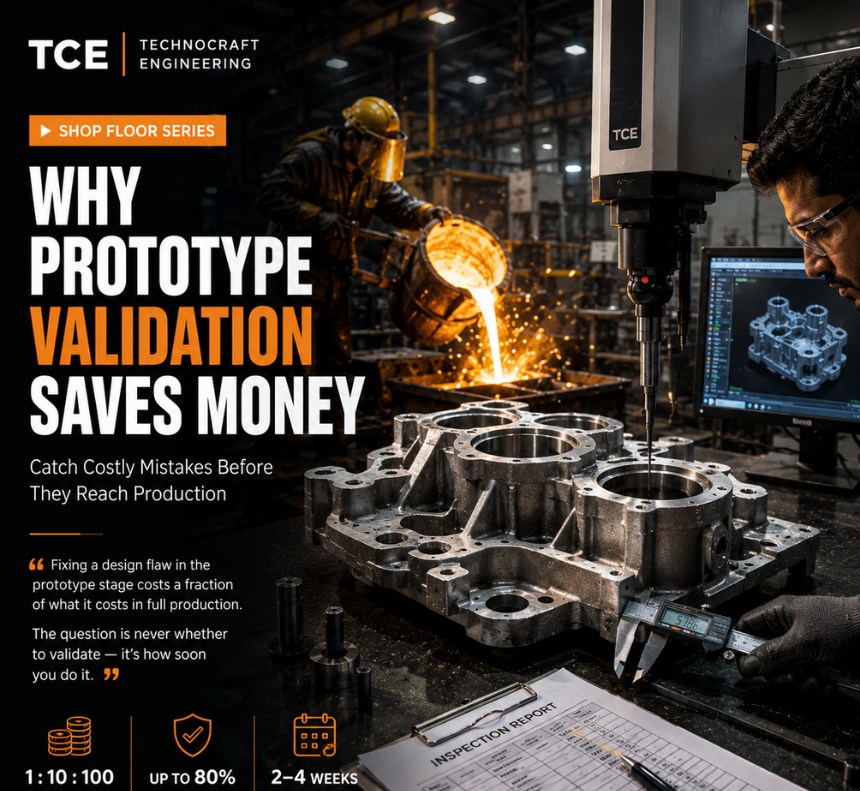
Why Prototype Validation Saves Money
“Fixing a design flaw in the prototype stage costs a fraction of what it costs in full production. The question is never whether to validate — it’s how soon you do it.”
The Hidden Cost of Skipping Validation
Every manufacturing business understands the pressure to move fast. When a customer sends a drawing and wants castings delivered, the temptation is to jump straight to production tooling — to skip the prototype stage, save a few weeks, and get metal on the floor as quickly as possible.
It is one of the most expensive decisions a foundry or its customer can make.
At Technocraft Engineering (TCE), we have seen it play out many times: a design flaw that would have cost ₹50,000 to catch and fix at the prototype stage becomes a ₹50 lakh problem when it surfaces in full production — in scrapped tooling, rejected castings, customer line stoppages, and in the worst cases, product recalls and liability claims.
Prototype validation is not a delay. It is the investment that makes the rest of the project run smoothly.
The 1 : 10 : 100 Rule of Manufacturing Defects
There is a well-established principle in manufacturing engineering: the cost of correcting a defect multiplies by roughly 10 times at each successive stage of the production process. A mistake caught on paper costs almost nothing to fix. The same mistake caught after production tooling is complete costs 50 to 80 times more. Caught after the customer has received and machined the parts, the cost can be 100 to 200 times the original correction cost — before accounting for reputational damage.
The table below illustrates how this applies specifically to casting projects.
| STAGE | RELATIVE COST TO FIX | WHAT GOES WRONG IF YOU WAIT |
| Design / Drawing | 1× | A dimension is wrong on paper. Corrected in minutes with no material cost. |
| Pattern / Prototype | 5–10× | Pattern rework or a second prototype pour. Some tooling cost, minimal schedule impact. |
| Production Tooling | 50–80× | Hard tooling must be reworked or scrapped. Lead time lost. Customer schedules affected. |
| Customer Receipt | 100–200× | Recall, rework at customer site, warranty claims, reputational damage, potential liability. |

What Prototype Validation Catches
A casting prototype is not simply a proof-of-concept. At TCE, every prototype is a full functional casting produced under conditions that closely replicate what production will look like. It is subjected to the same dimensional inspection, the same visual assessment, and where required, the same non-destructive testing as a production part.
This means that every issue the prototype reveals is an issue that would have occurred — identically, at volume — in full production. The table below shows the most common issues our engineers catch at the prototype stage, and what those issues would have cost if they had reached full production.
| ISSUE CAUGHT IN PROTOTYPE | COST IF CAUGHT IN FULL PRODUCTION |
| Incorrect draft angle causing ejection damage | Recut production tool; scrap first-off batch; delay 3–6 weeks |
| Parting line misalignment generating flash | 100% rework of cast parts; pattern re-machining |
| Wall section too thin causing misrun | Scrap entire production run; full process re-qualification |
| Core shift creating dimensional error | Failed incoming inspection; customer line stoppage |
| Shrinkage porosity in critical bore area | Warranty returns post-machining; liability exposure |
| Gating-induced sand inclusion | Scrapped machined components; premium rework cost |
| Dimensional non-conformance to drawing | Customer rejection; corrective action; audit risk |
TCE’s Prototype Validation Process
From First Drawing to Approved Production Design
| Drawing Review & DFM Analysis Before any material is committed, our engineers review customer drawings for casting feasibility. Draft angles, wall thickness, parting line placement, and undercut risk are all assessed. Issues flagged here cost nothing to fix. |
| Prototype Pattern Manufacture A prototype pattern is produced — typically in resin or aluminium for speed and economy. This pattern captures all critical geometry without the lead time or cost of a full steel production tool. |
| Trial Casting Pour Trial castings are poured using the prototype tooling. Metal fills the mould under production representative conditions. The casting is allowed to cool and is then extracted and cleaned for inspection. |
| Dimensional & Visual Inspection Every trial casting is fully inspected against the customer drawing: all critical dimensions checked with CMM equipment, surface finish assessed, and visual inspection carried out for obvious casting defects such as misruns, cold shuts, or shrinkage. |
| Internal Soundness Testing Where specified, castings are sectioned, radiographed, or ultrasonically tested to confirm internal soundness. Any porosity, shrinkage voids, or inclusions discovered at this stage are traceable to a specific design or process variable — and are corrected before hard tooling is made. |
| Design Lock & Production Sign-Off Once the prototype casting meets all dimensional and quality requirements, the design is locked. Production tooling is manufactured from the approved prototype specification. Full documentation is issued and retained for traceability. |
Speed Without Validation Is an Illusion
The argument against prototype validation is almost always speed. “We don’t have time for a prototype.” “We need to be in production in six weeks.” “We’ve made similar parts before.”
These arguments collapse the moment a problem appears in production. A six-week timeline that skips validation and then encounters a critical defect at production launch does not save six weeks — it loses three to six months. Tooling must be reworked or remade. Castings must be scrapped or reworked. Customer schedules slip. The foundry’s reputation takes a hit that lasts far longer than the delay itself.
At TCE, our prototype-to-approval timeline is typically two to four weeks. For most casting projects, this is not a delay — it is the fastest path to a production launch that runs clean from the first pour.
When Prototyping Matters Most
While prototype validation adds value to any casting project, it is absolutely essential in the following scenarios: • New part designs with no prior casting history
• Complex geometries with thin walls, deep cores, or tight tolerances
• Safety-critical or structurally loaded components
• Parts that will undergo significant post-casting machining
• Projects transitioning from a different manufacturing process (e.g. fabrication to casting) • High-volume programmes where defect rates at scale have catastrophic financial consequences • Customer-specified qualification requirements such as PPAP, FAI, or first article inspection
The TCE Advantage: In-House End-to-End Validation
Many foundries that offer prototype validation outsource parts of the process — sending patterns to external shops, using third-party inspection services, or sub-contracting non-destructive testing. Each handover is a point where communication can break down, timelines can slip, and accountability can blur.
At TCE, the entire validation chain operates under one roof. Our pattern shop produces the prototype tooling. Our foundry pours and processes the castings. Our quality team carries out dimensional inspection on our own CMM equipment. Internal soundness testing is conducted on-site. When a change is needed, pattern maker, foundry engineer, and quality inspector are in the same building — often reviewing the same casting together.
This integration means faster turnaround, cleaner communication, and a single point of accountability for every outcome. Our customers do not manage a chain of suppliers through the validation process. They manage one relationship with TCE.
Industries We Serve
| Automotive | Heavy Engineering | Pump & Valve | Infrastructure |
| General Industrial | Oil & Gas | Power Generation | Agricultural Equipment |
READY TO VALIDATE YOUR NEXT CASTING PROJECT?
Bring us your drawings, 3D models, or rough concepts. We’ll assess your design for casting feasibility, produce a prototype, and validate it before a single rupee is committed to production tooling.
✉ info@technocraftengineering.com ☎ +91 9373278832