
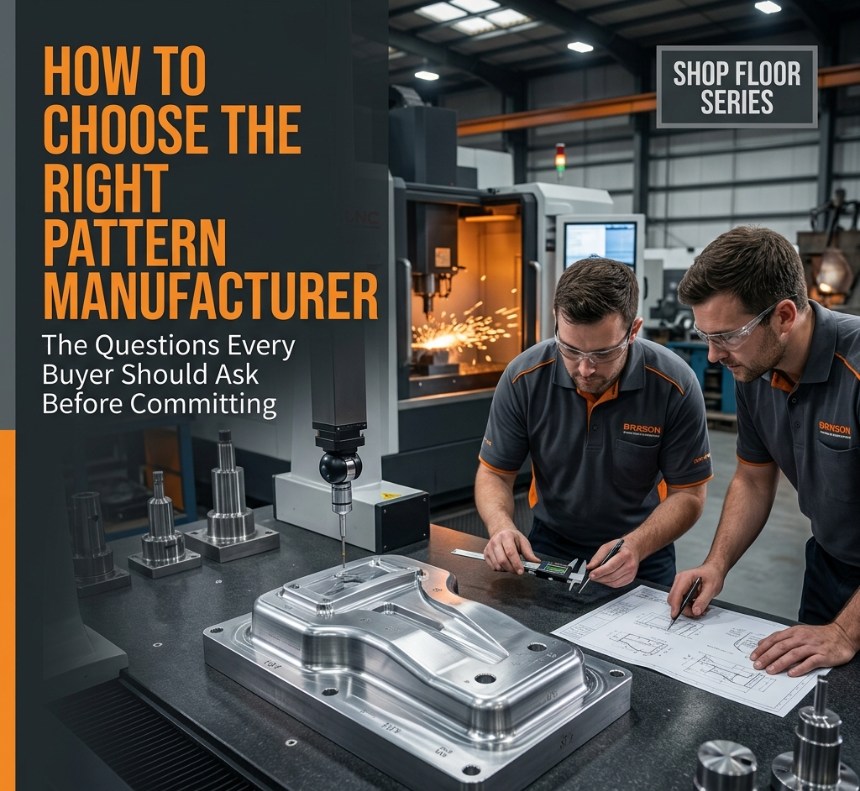
How To Choose Right Pattern Manufacturer
“The pattern manufacturer you choose does not just make a tool — they make a decision about the quality, consistency, and cost of every casting that will ever come from it. Choose carefully.”
Why the Choice of Pattern Manufacturer Matters More Than You Think
In metal casting, the pattern is the foundation of everything. It defines the shape, the dimensional accuracy, the surface quality, and the consistency of every casting that will ever be produced from it. A great casting cannot come from a poor pattern. And a poor pattern manufacturer will cost you far more than the initial tooling invoice suggests.
Yet the pattern manufacturer is often chosen on price alone — a decision made quickly, with limited due diligence, in the rush to get a project moving. This is one of the most common and costly mistakes in casting procurement.
This guide is designed to help engineers, procurement managers, and project leads ask the right questions, spot the warning signs, and identify a pattern manufacturer who will deliver quality tooling that performs over its full production life.
What a Pattern Manufacturer Actually Does
A pattern manufacturer’s job does not begin when material is cut or end when the pattern is delivered. A genuine pattern manufacturing partner is involved from the design stage — reviewing drawings for casting feasibility, advising on draft angles and parting line placement, selecting the right material for the application, and validating the final tool through trial casting before production begins.
At Technocraft Engineering (TCE), our pattern shop operates as an integrated part of our casting operation. Pattern makers, design engineers, and foundry teams work side by side. The result is a pattern that is not just accurately made — it is made to cast well, consistently, at volume.
When evaluating any pattern manufacturer, the question to keep in mind is: are they making a shape, or are they engineering a casting solution?

One of the first and most important decisions in pattern manufacturing is material selection. The correct choice depends on your production volume, the alloy being cast, the dimensional tolerances required, and your long-term tooling budget. A manufacturer who does not ask about these factors before recommending a material is not giving you the right advice.
| MATERIAL | BEST FOR | PRODUCTION VOLUME | TYPICAL LIFESPAN |
| Wood (Teak / Mahogany) | Prototypes & very low-volume trials | 1 – 50 shots | 50 – 200 shots |
| Resin / Polyurethane | Prototype & short run; fast lead time | 50 – 500 shots | 200 – 1,000 shots |
| Aluminium Alloy | Medium-volume production; complex geometry | 500 – 5,000 shots | 5,000 – 20,000 shots |
| Crucible Steel | High-volume; tight tolerance; long life | 5,000+ shots | 10,000 – 50,000+ shots |
At TCE, we select pattern material based on your specific production requirements — not on what is easiest to make. For high-volume automotive and industrial components, crucible steel is our material of choice: it holds dimensional accuracy across tens of thousands of impressions and requires far less maintenance than softer materials over its production life.
Questions to Ask Every Pattern Manufacturer
Use the checklist below when evaluating any pattern shop. The answers — or the absence of clear answers — will tell you a great deal about the quality and professionalism of the operation.
| # | ASK YOUR MANUFACTURER | WHY IT MATTERS |
| 1 | Do you manufacture patterns in house? | Outsourced pattern work introduces delays, communication gaps, and divided accountability. In house production means faster iteration and a single point of responsibility. |
| 2 | What materials do you work with — wood, resin, aluminium, steel? | The right material depends on your volume and alloy. A manufacturer who only works in one material may steer you toward the wrong solution for your application. |
| 3 | What tolerances can you hold on split line and critical features? | Vague answers here are a red flag. A professional pattern shop will quote specific tolerance capabilities — for example, ±0.01 mm on split line, ±0.05 mm on feature geometry. |
| 4 | Do you use CNC machining or hand making? | CNC machining delivers repeatability and dimensional accuracy that hand-making cannot match at scale. Both have a role, but high-volume production patterns demand CNC. |
| 5 | Can you perform dimensional inspection with CMM equipment? | Visual inspection alone is insufficient for precision patterns. CMM verification gives you traceable, documented proof that the pattern meets drawing. |
| 6 | Is your foundry in-house or do you outsource casting trials? | An in-house foundry means pattern makers and casting engineers can collaborate directly, iterate quickly, and fix problems in days rather than weeks. |
| 7 | Do you maintain pattern records and offer scheduled maintenance? | Patterns are capital assets. A manufacturer who tracks maintenance cycles and offers reconditioning will extend your tooling life and protect your casting quality over time. |
| 8 | Can you show previous work in my industry or on similar components? | Relevant experience matters. A pattern maker who understands automotive brake components thinks differently from one who has only worked on simple industrial brackets. |
Red Flags & Green Flags: Reading the Signs
Beyond the answers to specific questions, there are broader signals that indicate whether a pattern manufacturer is operating at a professional standard. The table below contrasts the warning signs that should give you pause with the indicators of a manufacturer you can trust with your tooling.
| ⚠ RED FLAGS TO WATCH FOR | ✔ SIGNS OF A SERIOUS MANUFACTURER |
| ❌ Cannot quote a specific tolerance figure | ✅ Quotes split line tolerance of ±0.01 mm or better |
| ❌ Foundry trials outsourced to a third party | ✅ Pattern shop and foundry operate under one roof |
| ❌ No CMM or dimensional inspection capability | ✅ CMM inspection standard on every completed pattern |
| ❌ Pattern records not maintained or unavailable | ✅ Every pattern has a serial number and maintenance log |
| ❌ Communicates only by price, not process | ✅ Explains their process, materials, and quality controls |
| ❌ Cannot provide industry-relevant references | ✅ Demonstrated experience in your component type or sector |
| ❌ Rushes past design review to reach production | ✅ Insists on DFM review before any material is committed |
| ❌ No formal approval process before production | ✅ Written sign-off required before production tooling proceeds |
A Structured Approach to Selecting Your Pattern Manufacturer
Six Steps From Initial Brief to Confident Commitment
| Define Your Production Volume & Alloy Before approaching any manufacturer, know your numbers: how many castings per year, what alloy, and over what timeframe. These inputs determine the right pattern material and construction method — and a good manufacturer will ask you these questions first. |
| Assess In-House Versus Outsourced Capability Ask every potential manufacturer to map out exactly what they do in-house versus what they send out. Pattern making, CNC machining, hand finishing, inspection, and trial casting should all ideally sit under one roof. Every outsourced step is a risk. |
| Request a Technical Review of Your Drawing Ask the manufacturer to perform a Design for Manufacturability (DFM) review of your component drawing before quoting. The quality and depth of this review tells you a great deal about their engineering capability. |
| Visit the Facility There is no substitute for a site visit. Walk the pattern shop floor. Look at the CNC equipment, the inspection room, the storage conditions for existing patterns. Talk to the pattern makers. The physical environment tells you how seriously a manufacturer takes quality. |
| Ask for References in Your Sector Request customer references — ideally in your industry or for components of similar complexity. Ask those customers specifically about quality consistency, response to problems, and communication during the project. |
| Evaluate Total Cost, Not Just Unit Price A pattern that costs 20% less but wears out in half the shots, requires frequent maintenance, or produces inconsistent castings is not cheaper — it is more expensive. Evaluate tooling cost over its full production life, not just the initial invoice. |
Think Total Cost of Ownership, Not Tooling Price
Pattern tooling is not a commodity purchase. The price on the quotation is only part of the cost story. A pattern that is ₹30,000 cheaper than a competitor’s quote but delivers 40% fewer shots before needing reconditioning is not the better option — it is the more expensive one over the life of your programme.
When evaluating pattern quotes, ask every manufacturer to provide:
• Expected tooling lifespan in production shots
• Recommended maintenance interval and estimated reconditioning cost
• Tolerance capability across the pattern lifetime, not just at first use
• Warranty terms on dimensional accuracy
• What happens if the pattern fails to meet drawing on first inspection
A manufacturer who cannot answer these questions clearly has not thought about your production requirements beyond the initial order. A manufacturer who answers them with specific, documented commitments is one you can build a long-term supply relationship with.
The Case for an In-House Pattern and Foundry Operation
The strongest argument for choosing a pattern manufacturer who also operates an in-house foundry is accountability. When the same organisation makes the pattern and pours the first castings, there is nowhere to hide if something goes wrong. Problems are diagnosed and resolved in days, not weeks. Pattern modifications are made quickly, without the logistics of shipping tooling between suppliers.
At TCE, this integrated model is central to how we operate. Our customers do not manage the interface between a pattern shop and a foundry. They deal with one team, one schedule, and one quality standard from first drawing to approved production casting.
If the pattern manufacturer you are evaluating sends trial castings to a third-party foundry, ask yourself what happens when the pattern needs adjustment after the trial. Who owns that conversation? Who pays for the delay? Who is accountable for the outcome?
Industries Technocraft Engineering Serves
- Automotive
- Heavy Engineering
- Pump & Valve
- Infrastructure
- General Industrial
- Oil & Gas
- Power Generation
- Agricultural Equipment
- Infrastructure
Bring us your drawings, specifications, or rough concepts. We will assess, advise, and build the right pattern for your application — with in-house casting trials, CMM inspection, and full traceability from day one.